

The Shahrebours Analytical News Agency, in collaboration with capital market analysts, has reviewed Zob’s technical analysis. This analysis aims to assess the current status of the stock and identify its price trends.
It should be noted that this analysis does not represent a buy or sell signal and is provided solely to inform the audience about the conditions of this symbol. Investors should also consider all analytical and fundamental aspects before making any decisions.
Zob Technical Analysis | June 2025
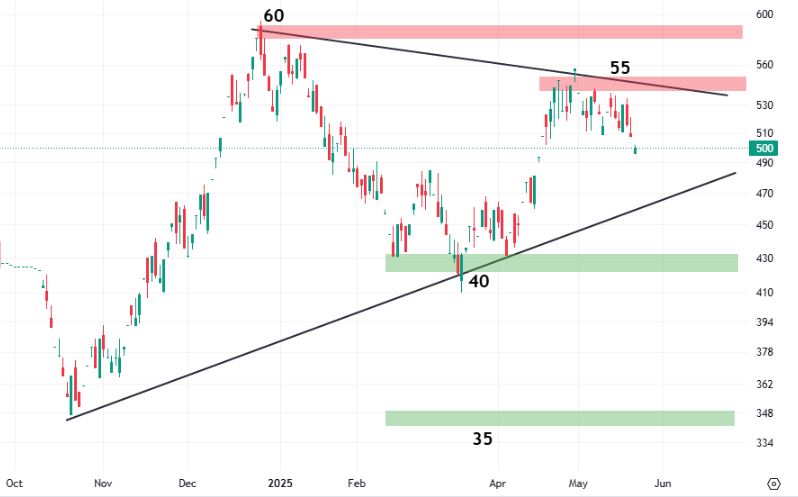
Investors and analysts of the Zob symbol have been facing a neutral and eroding triangle trend in recent months, which has created challenges for decision-making. The breakdown of this indecisive situation and the start of an upward or downward trend depends entirely on the price’s reaction to sensitive levels of resistance and support.
The critical resistance zone is located between 55 and 60 Tomans; a decisive crossing of this range could promise a price jump. On the other hand, the loss of key supports of 40 and especially 35 Tomans would sound the alarm for a further fall and could lead to the start of a strong downward trend.
Therefore, careful and intelligent monitoring of price movements in these designated areas is essential for every forex trader and will be their main guide in making smart buy or sell decisions.
Zob Technical Analysis | January 2024
The Zob symbol has attracted a lot of attention since the beginning of November with a remarkable growth of 70%. However, this upward trend stopped at the resistance level of 60 Tomans and seems to have lost some of its strength in the last month.
Currently, two main scenarios for the future of Zob technical analysis can be predicted:
Bearish scenario: If the 50 Tomans support is broken, there is a possibility of a further price decrease to the 44 Tomans range. This could be due to selling pressure and reduced demand for the share.
Bullish scenario: However, if the price can return from the 50 Tomans support and break the 60 Tomans resistance, we can hope that a new season of growth has begun and the symbol will move towards its historical ceiling. Breaking this strong resistance will indicate the power of buyers and overcoming selling pressure.

Technical Analysis of Zob Ahan Isfahan (Zob)
Zob Ahan Isfahan Company, with the symbol “Zob”, is one of the most prominent symbols in the Iranian stock market and the steel industry. The company, which was established in 1974 and went public in October 2011, plays a vital role in supplying domestic and foreign steel products.
Market Performance and Volatility
In the past year, the Zob symbol has experienced significant fluctuations. From mid-May to the end of August, Zob’s stock price fell by 50 percent, but since the beginning of September, it has continued its upward trend with a growth of more than 36 percent. This change in trend is due to the change in market behavior and the increase in demand for steel products.
Fundamental Analysis and Products
In the technical analysis of Zob, we refer to the foundation and products. Zob Ahan Isfahan plays an important role in the market by producing various steel sections, including steel beams, rebars, and steel sheets. The company has a 13% share in steel ingot production, 6% in rebar production, and 66% in beam production in Iran.
Also, changes in the global sales rate of products, the dollar rate, and the costs of supplying raw materials are key factors affecting the company’s performance.
Trading statistics and returns In the past three months, Zob’s shares have grown by 90.23% and in the last six months, by 89.19%. These increases indicate positive returns for the symbol in different periods, although in the last week we have witnessed a 5.5% decrease in the share price, which is due to market fluctuations.
Factors affecting performance Key factors affecting the company’s performance include the global sales rate of products, the dollar rate, the costs of supplying raw materials, and the boom in the sales market. The growth of the dollar rate can lead to the recognition of profits from product exports and currency exchange. Also, the increase in the costs of raw materials can affect production costs.